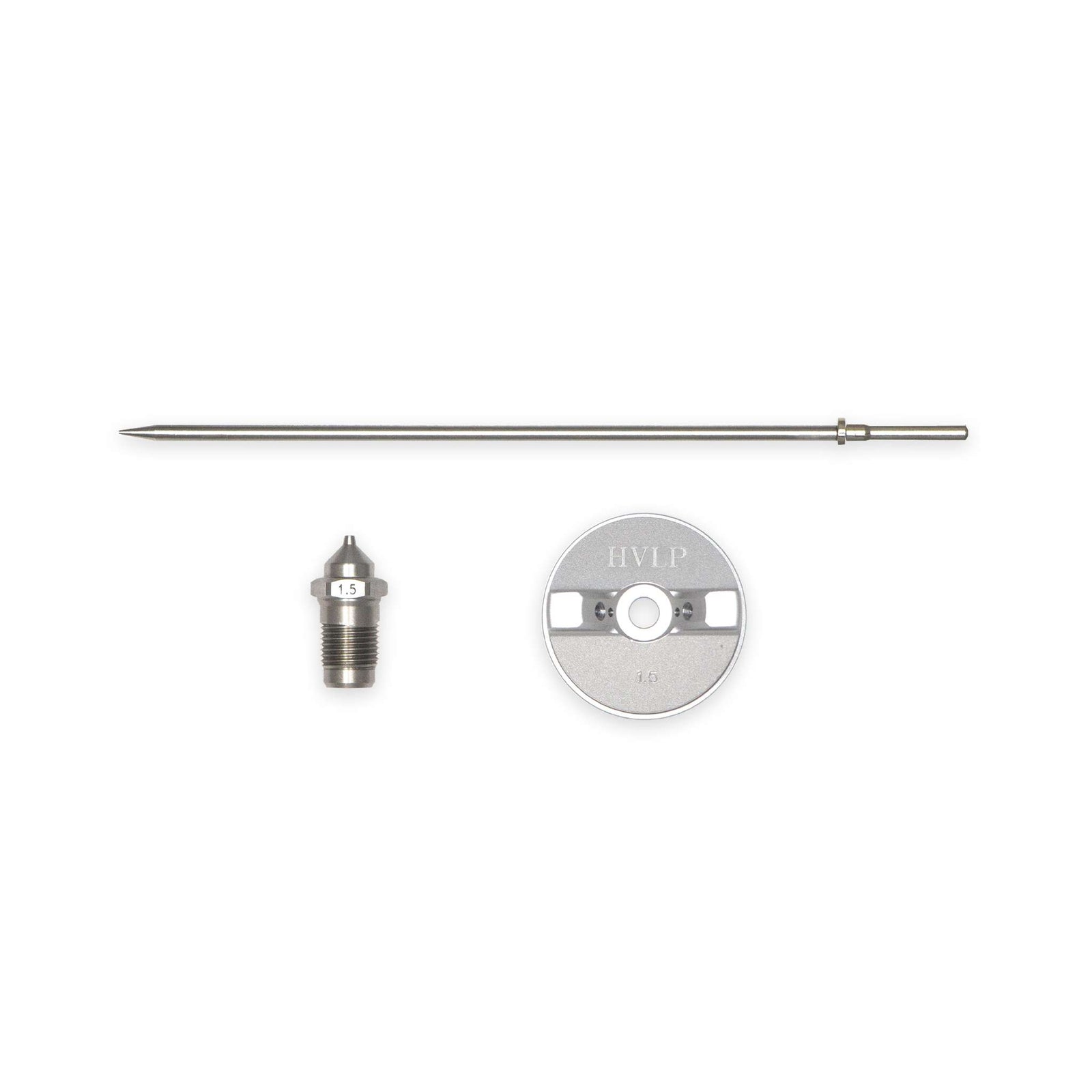
Match air cap size to the material you spray — and know which sets fit the gun you own.
Three matched parts, and why you buy them together
Most people call it "the tip" or "the nozzle." It is actually three parts working as a set, and understanding that is what keeps you from ordering the wrong thing.
The nozzle and needle must be the same size. That pairing is what sets how much material moves through the gun, and they are machined to work together. Mixing a 1.3 mm needle with a 1.5 mm nozzle is the single most common reason a gun spits, leaks or will not spray properly — and it is the reason Fuji sells these as a matched set rather than three loose parts.
The air cap has a little more latitude. Once the nozzle and needle are matched, the air cap can go one size up or down to fine-tune atomization. This is the adjustment experienced sprayers reach for when the material is laying down almost right but not quite — a slightly larger cap for more air over a heavier material, a slightly smaller one for a finer break-up on a thin finish. It is worth knowing the option exists, but it is a refinement, not where you start.
So: buy the set. One part number, three matched pieces, no guesswork. It is also the cheapest way to change what your gun can do — the same gun sprays a delicate dye or a high-build primer depending on which set is fitted, and a swap takes a few minutes with no tools beyond a wrench.
Most people call it "the tip" or "the nozzle." It is actually three parts working as a set, and understanding that is what keeps you from ordering the wrong thing.
The nozzle and needle must be the same size. That pairing is what sets how much material moves through the gun, and they are machined to work together. Mixing a 1.3 mm needle with a 1.5 mm nozzle is the single most common reason a gun spits, leaks or will not spray properly — and it is the reason Fuji sells these as a matched set rather than three loose parts.
The air cap has a little more latitude. Once the nozzle and needle are matched, the air cap can go one size up or down to fine-tune atomization. This is the adjustment experienced sprayers reach for when the material is laying down almost right but not quite — a slightly larger cap for more air over a heavier material, a slightly smaller one for a finer break-up on a thin finish. It is worth knowing the option exists, but it is a refinement, not where you start.
So: buy the set. One part number, three matched pieces, no guesswork. It is also the cheapest way to change what your gun can do — the same gun sprays a delicate dye or a high-build primer depending on which set is fitted, and a swap takes a few minutes with no tools beyond a wrench.
What each air cap size is for
Air cap size is decided by what you are spraying, not by which gun you own. Thicker material needs a bigger opening to pass through; thinner material atomizes better through a smaller one. Everything else follows from that.
0.7 – 1.0 mm — thin and fine
Inks, dyes, stains, sealers, shellac and thin water-based lacquers. Artists' work, touch-up, small detail. This is where atomization is finest, so it is also where a clear finish looks its best.
1.3 – 1.4 mm — the all-rounderCatalyzed lacquers, waterborne finishes, automotive enamels, polyurethane, and latex on cabinetry and trim. If you own one air cap set, this is it, and it is what Fuji ships on most guns. Which of the two you want depends on your gun: T-Model and M-Model use 1.3 mm, and the G-XPC uses 1.4 mm. Neither family makes the other's size.
1.5 mm — larger surfaces
Walls, ceilings, doors and panels. Primers and oil-based paints. The step you take when 1.3 mm is working but slowly.
1.8 mm — thick coatings
Epoxies, adhesives, multi-fleck and heavy-bodied materials that will not pass a smaller nozzle without being thinned past sense.
2.0 – 2.5 mm — heavy and industrial
Industrial primers, texture coatings, and heavy latex over large areas. Only the T-Model reaches 2.5 mm.
The trade-off, in one sentence
Every step up in size lets you spray thicker material; every step down improves how finely that material breaks up. A 1.0 mm cap will lay a clear coat down more beautifully than a 1.5 mm ever will — and a 1.0 mm cap will not pass a high-build primer at all.
Thinning is the other half of this
If your material is too thick for the cap you have, you can often thin it rather than buy a new set. Thinning is normal practice, not a failure. But every coating has a maximum dilution specified by its manufacturer, and going beyond it to suit a smaller air cap will cost you film build, adhesion and durability. The product will spray, and then it will not perform. When the material genuinely needs a bigger opening, buy the bigger set.
Keep this in the shop
Fuji's Air Cap Quick Reference Sheet is a one-page summary of size against material. Print it and pin it up near the bench — it answers most of these questions faster than a phone does. Fuji’s two-minute walkthrough below shows how to read the Quick Reference Guide itself.
Air cap size is decided by what you are spraying, not by which gun you own. Thicker material needs a bigger opening to pass through; thinner material atomizes better through a smaller one. Everything else follows from that.
0.7 – 1.0 mm — thin and fine
Inks, dyes, stains, sealers, shellac and thin water-based lacquers. Artists' work, touch-up, small detail. This is where atomization is finest, so it is also where a clear finish looks its best.
1.3 – 1.4 mm — the all-rounderCatalyzed lacquers, waterborne finishes, automotive enamels, polyurethane, and latex on cabinetry and trim. If you own one air cap set, this is it, and it is what Fuji ships on most guns. Which of the two you want depends on your gun: T-Model and M-Model use 1.3 mm, and the G-XPC uses 1.4 mm. Neither family makes the other's size.
1.5 mm — larger surfaces
Walls, ceilings, doors and panels. Primers and oil-based paints. The step you take when 1.3 mm is working but slowly.
1.8 mm — thick coatings
Epoxies, adhesives, multi-fleck and heavy-bodied materials that will not pass a smaller nozzle without being thinned past sense.
2.0 – 2.5 mm — heavy and industrial
Industrial primers, texture coatings, and heavy latex over large areas. Only the T-Model reaches 2.5 mm.
The trade-off, in one sentence
Every step up in size lets you spray thicker material; every step down improves how finely that material breaks up. A 1.0 mm cap will lay a clear coat down more beautifully than a 1.5 mm ever will — and a 1.0 mm cap will not pass a high-build primer at all.
Thinning is the other half of this
If your material is too thick for the cap you have, you can often thin it rather than buy a new set. Thinning is normal practice, not a failure. But every coating has a maximum dilution specified by its manufacturer, and going beyond it to suit a smaller air cap will cost you film build, adhesion and durability. The product will spray, and then it will not perform. When the material genuinely needs a bigger opening, buy the bigger set.
Keep this in the shop
Fuji's Air Cap Quick Reference Sheet is a one-page summary of size against material. Print it and pin it up near the bench — it answers most of these questions faster than a phone does. Fuji’s two-minute walkthrough below shows how to read the Quick Reference Guide itself.
What the finish tells you, and how to check before you spray
You do not need to guess. Both mistakes have a signature, and both show up on a test panel before they show up on your work.
Signs the cap is too small for the material
Signs the cap is too large for the material
When it is right
One steady pass lays down an even wet coat that flows out flat as it levels. The mist looks fine rather than granular, the pattern is consistent from edge to edge, and you are not fighting the gun to get coverage.
Check the material before you check the cap
Every coating has a viscosity spec on its technical data sheet, and a viscosity cup — you time how long the material takes to drain through — tells you where yours actually sits. It takes a minute and removes the guesswork about whether the problem is the cap or the mix. Stir thoroughly first; a finish that has sat on a shelf is thicker at the bottom than the top.
Then test on scrap
Always. A piece of cardboard or an offcut of the same material, sprayed the same way you will spray the work. Adjust the fan and fluid controls first — a good many problems people blame on the air cap are a control set wrong — and only change the cap if the pattern is still not right after that.
You do not need to guess. Both mistakes have a signature, and both show up on a test panel before they show up on your work.
Signs the cap is too small for the material
Signs the cap is too large for the material
When it is right
One steady pass lays down an even wet coat that flows out flat as it levels. The mist looks fine rather than granular, the pattern is consistent from edge to edge, and you are not fighting the gun to get coverage.
Check the material before you check the cap
Every coating has a viscosity spec on its technical data sheet, and a viscosity cup — you time how long the material takes to drain through — tells you where yours actually sits. It takes a minute and removes the guesswork about whether the problem is the cap or the mix. Stir thoroughly first; a finish that has sat on a shelf is thicker at the bottom than the top.
Then test on scrap
Always. A piece of cardboard or an offcut of the same material, sprayed the same way you will spray the work. Adjust the fan and fluid controls first — a good many problems people blame on the air cap are a control set wrong — and only change the cap if the pattern is still not right after that.
The four ranges, and why they are not interchangeable
This is the part that costs people money. Each Fuji gun family uses its own air cap sets. They look similar, they are not.
This is the part that costs people money. Each Fuji gun family uses its own air cap sets. They look similar, they are not.

Ships with 1.3 mm.
Seven sizes: 0.8, 1.0, 1.3, 1.5, 1.8, 2.0 and 2.5 mm.
The widest range Fuji offers, and the only family that reaches 2.5 mm.
Ships with 1.3 mm.
Seven sizes: 0.8, 1.0, 1.3, 1.5, 1.8, 2.0 and 2.5 mm.
The widest range Fuji offers, and the only family that reaches 2.5 mm.

Ships with 1.3 mm.
Six sizes: 0.8, 1.0, 1.3, 1.5, 1.8 and 2.0 mm.
No 2.5 mm, so the heaviest coatings are out of range.
Ships with 1.3 mm.
Six sizes: 0.8, 1.0, 1.3, 1.5, 1.8 and 2.0 mm.
No 2.5 mm, so the heaviest coatings are out of range.

Ships with 1.4 mm.
Five sizes: 0.7, 1.0, 1.4, 1.8 and 2.2 mm.
The only family that goes below 0.8 mm, and note there is no 1.3 mm in this range — 1.4 mm is the G-XPC equivalent.
Ships with 1.4 mm.
Five sizes: 0.7, 1.0, 1.4, 1.8 and 2.2 mm.
The only family that goes below 0.8 mm, and note there is no 1.3 mm in this range — 1.4 mm is the G-XPC equivalent.
Two sizes: 1.0 and 1.8 mm. Ships with 1.0 mm. Its own range, separate from all three families above. The 1.8 mm is worth knowing about if you use the Touch-Up gun for heavier material on small parts.
Two sizes: 1.0 and 1.8 mm. Ships with 1.0 mm. Its own range, separate from all three families above. The 1.8 mm is worth knowing about if you use the Touch-Up gun for heavier material on small parts.
Why most people end up with two or three
Your gun came with one, and for a while that is enough. Then you take on a job the material does not suit, and you find out how much time you can lose fighting a cap that was never going to work.
Start with what your gun shipped with. 1.3 mm on a T-Model or M-Model, 1.4 mm on a G-XPC. It covers most of what most people spray, and there is no reason to buy a second set before you have hit its limits.
Your second set is decided by what you spray most.
That pairing — the standard cap plus one either side of it — covers the great majority of finishing work. A third set is worth it once you know which end of the range you actually live at.
Three reasons a second set pays for itself
They are wearing parts, too. The nozzle and needle are precision-machined, and over years of use — particularly with abrasive or pigmented materials — they wear. A gun that used to spray beautifully and now will not is often a tired air cap set rather than a tired gun. Keeping a spare of your standard size means a worn one never costs you a day's work.
Keep them organized
Once you own more than one, they are small, they look alike and they are easy to mix up — which is how needles and nozzles end up mismatched. Fuji makes an air cap set carry case (part 5137) that holds T-Model and M-Model sets and keeps each one together as a set.
Your gun came with one, and for a while that is enough. Then you take on a job the material does not suit, and you find out how much time you can lose fighting a cap that was never going to work.
Start with what your gun shipped with. 1.3 mm on a T-Model or M-Model, 1.4 mm on a G-XPC. It covers most of what most people spray, and there is no reason to buy a second set before you have hit its limits.
Your second set is decided by what you spray most.
That pairing — the standard cap plus one either side of it — covers the great majority of finishing work. A third set is worth it once you know which end of the range you actually live at.
Three reasons a second set pays for itself
They are wearing parts, too. The nozzle and needle are precision-machined, and over years of use — particularly with abrasive or pigmented materials — they wear. A gun that used to spray beautifully and now will not is often a tired air cap set rather than a tired gun. Keeping a spare of your standard size means a worn one never costs you a day's work.
Keep them organized
Once you own more than one, they are small, they look alike and they are easy to mix up — which is how needles and nozzles end up mismatched. Fuji makes an air cap set carry case (part 5137) that holds T-Model and M-Model sets and keeps each one together as a set.
Get the family right, then the size.
You have the two things you need: the size that suits your material, and the range that fits your gun. Order by gun family first and size second, and if you are between two sizes, take the smaller one — you can thin a material to suit a smaller cap, but you cannot make a large one atomize finely.
Not sure which gun you own? Use Fuji's Spray Gun Identification Guide, or send us a photo at hello@spraysystem.store and we will tell you what you have and what fits it.
Spraying something unusual? Chocolate, sunless tanning, artists' inks, industrial coatings with an awkward viscosity — get in touch. Tell us the material and its technical data sheet if you have it, and we will work out the cap and cup combination that suits it.
Still choosing equipment? Start with the HVLP Turbine Buying Guide for stage count and pressure, then the HVLP Spray Gun Buying Guide for feed style and cup size.
Get the family right, then the size.
You have the two things you need: the size that suits your material, and the range that fits your gun. Order by gun family first and size second, and if you are between two sizes, take the smaller one — you can thin a material to suit a smaller cap, but you cannot make a large one atomize finely.
Not sure which gun you own? Use Fuji's Spray Gun Identification Guide, or send us a photo at hello@spraysystem.store and we will tell you what you have and what fits it.
Spraying something unusual? Chocolate, sunless tanning, artists' inks, industrial coatings with an awkward viscosity — get in touch. Tell us the material and its technical data sheet if you have it, and we will work out the cap and cup combination that suits it.
Still choosing equipment? Start with the HVLP Turbine Buying Guide for stage count and pressure, then the HVLP Spray Gun Buying Guide for feed style and cup size.


We’re proud to be an Authorized Dealer of Fuji Spray, a brand trusted by woodworkers, cabinet makers, automotive refinishers, and artisans worldwide. When you choose Fuji Spray, you’re choosing innovation, reliability, and a beautiful finish — and when you choose Spray System Store, we are ready to back you up every step of the way.