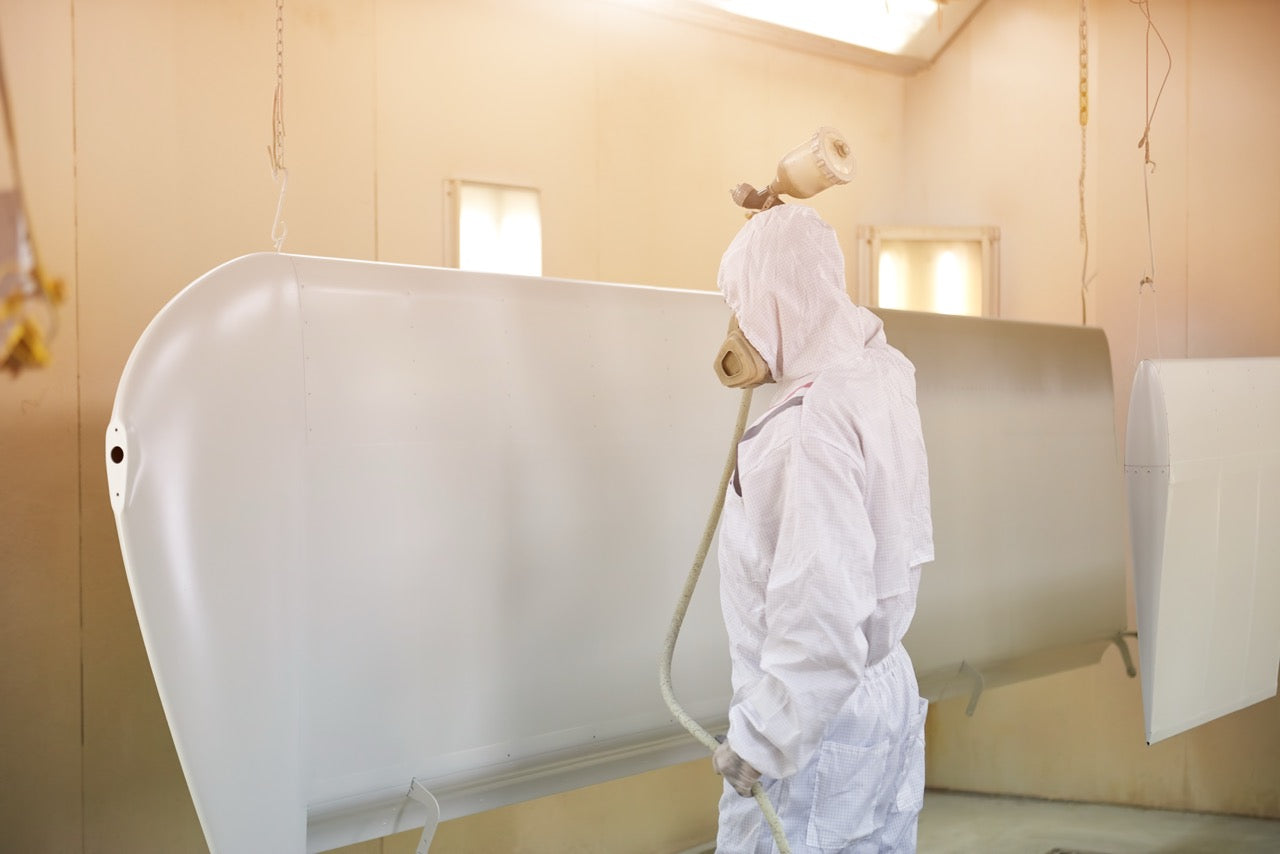
Cabinets, furniture, decks, boats, airplanes, chocolate. Pick your project and we will tell you which turbine, spray gun and air cap size to use.
Four reasons people make the move, and where you probably fit.
You are brushing and rolling, and it shows
Brush marks on cabinet doors. Roller texture on panels. Two days on trim that a gun covers in an afternoon. A spray gun lays finish down as a film instead of dragging it across the surface, so it flows out flat — and it reaches carvings, louvers and spindles a brush cannot.
You have a cheap sprayer or an airless, and the finish is not there
Both put material on the wall. Neither gives you a furniture-grade finish. Fuji quotes
upwards of 85% transfer efficiency, so most of what you paid for lands on the work rather than drifting around the room.
You have outgrown the turbine you own
The common one. You want to spray latex or primer without thinning, or just cover ground faster. Worth knowing:
your gun carries over. Fuji guns work across the turbine range, so you can buy the turbine alone and keep the gun you know. The
Turbine Buying Guide covers when that beats a complete system.
You want to do something your setup cannot
A different material, a smaller pattern, an awkward angle, a tiny batch. Usually not a new machine — a
different air cap size, a specialty cup, or a second gun so two colors stay loaded. The cheapest fix on this page.
Weekender or for a living?
If finishing pays your bills, buy for output and a machine that recovers between sessions. If it is a Saturday thing, buy the least expensive system that does the job comfortably and put the difference into a good gun.
Tight on budget?
Before you drop down a series, look at
Refurb, Scratch & Dent. Fuji restores a limited number of turbines to near-new condition and every one carries the full Fuji warranty. Stock comes and goes, but when the model you want appears it is the cheapest way to get it — and a better buy than settling for less machine.
Now the same question from the other side: pick your work, and we will tell you what to spray it with.
Four reasons people make the move, and where you probably fit.
You are brushing and rolling, and it shows
Brush marks on cabinet doors. Roller texture on panels. Two days on trim that a gun covers in an afternoon. A spray gun lays finish down as a film instead of dragging it across the surface, so it flows out flat — and it reaches carvings, louvers and spindles a brush cannot.
You have a cheap sprayer or an airless, and the finish is not there
Both put material on the wall. Neither gives you a furniture-grade finish. Fuji quotes
upwards of 85% transfer efficiency, so most of what you paid for lands on the work rather than drifting around the room.
You have outgrown the turbine you own
The common one. You want to spray latex or primer without thinning, or just cover ground faster. Worth knowing:
your gun carries over. Fuji guns work across the turbine range, so you can buy the turbine alone and keep the gun you know. The
Turbine Buying Guide covers when that beats a complete system.
You want to do something your setup cannot
A different material, a smaller pattern, an awkward angle, a tiny batch. Usually not a new machine — a
different air cap size, a specialty cup, or a second gun so two colors stay loaded. The cheapest fix on this page.
Weekender or for a living?
If finishing pays your bills, buy for output and a machine that recovers between sessions. If it is a Saturday thing, buy the least expensive system that does the job comfortably and put the difference into a good gun.
Tight on budget?
Before you drop down a series, look at
Refurb, Scratch & Dent. Fuji restores a limited number of turbines to near-new condition and every one carries the full Fuji warranty. Stock comes and goes, but when the model you want appears it is the cheapest way to get it — and a better buy than settling for less machine.
Now the same question from the other side: pick your work, and we will tell you what to spray it with.
Where most Fuji turbines spend their life.
Fuji built its reputation here. If you are finishing wood, almost any system in the range will do good work — the choice comes down to how thick your material is and how much you need to carry the turbine around.
Where most Fuji turbines spend their life.
Fuji built its reputation here. If you are finishing wood, almost any system in the range will do good work — the choice comes down to how thick your material is and how much you need to carry the turbine around.
Tip: Take the doors off and spray them flat. Back first, then edges, then the face — so the face is last and cleanest. A tinted primer under the color saves you a coat.
Tip: Take the doors off and spray them flat. Back first, then edges, then the face — so the face is last and cleanest. A tinted primer under the color saves you a coat.


Tip: Strain chalk and milk paint before it goes in the cup — they settle and lump. Spray legs and spindles first, flat surfaces last.
Tip: Strain chalk and milk paint before it goes in the cup — they settle and lump. Spray legs and spindles first, flat surfaces last.
Tip: Spray trim on sawhorses before it goes on the wall wherever you can. Narrow the fan for casing so you are not masking half the room.
Tip: Spray trim on sawhorses before it goes on the wall wherever you can. Narrow the fan for casing so you are not masking half the room.


Tip: Turn the fluid control well down — stain floods easily. Work in sections you can back-wipe inside the manufacturer's window.
Tip: Turn the fluid control well down — stain floods easily. Work in sections you can back-wipe inside the manufacturer's window.
Tip: Many light coats, sanded between. This is where a smaller air cap earns its money — atomization is finest at the bottom of the range.
Tip: Many light coats, sanded between. This is where a smaller air cap earns its money — atomization is finest at the bottom of the range.

Bigger surfaces, heavier material, and the weather to think about.
Outdoors, two things change. Coatings are thicker — solid stains and exterior paints ask more of a turbine than any interior finish. And you have wind, which decides how much of your material actually reaches the work.
Bigger surfaces, heavier material, and the weather to think about.
Outdoors, two things change. Coatings are thicker — solid stains and exterior paints ask more of a turbine than any interior finish. And you have wind, which decides how much of your material actually reaches the work.

Tip: Check the wind before you start and keep it at your back — overspray travels a long way outdoors. On bare or thirsty wood, back-brush the first coat so the finish works into the grain instead of sitting on it. Spray along the length of each board, never across.
Tip: Check the wind before you start and keep it at your back — overspray travels a long way outdoors. On bare or thirsty wood, back-brush the first coat so the finish works into the grain instead of sitting on it. Spray along the length of each board, never across.
Tip: On metal, the prep is the job. Remove every trace of rust, degrease thoroughly, and get the right primer down — a beautiful topcoat over contaminated steel will lift within a season. Keep coats thin on round and vertical sections, which run far more readily than a flat panel, and work in the shade. Hot metal flashes the finish before it can flow out.
Tip: On metal, the prep is the job. Remove every trace of rust, degrease thoroughly, and get the right primer down — a beautiful topcoat over contaminated steel will lift within a season. Keep coats thin on round and vertical sections, which run far more readily than a flat panel, and work in the shade. Hot metal flashes the finish before it can flow out.

Where the work will not come to you.
Cars, boats, planes and RVs have two things in common: the coatings are demanding, and the job is usually somewhere other than your shop. A turbine helps on both counts — it sprays high-viscosity material and it runs off an ordinary outlet, so there is no compressor to haul and nothing to plumb in at a marina, a hangar or a storage lot.
Where the work will not come to you.
Cars, boats, planes and RVs have two things in common: the coatings are demanding, and the job is usually somewhere other than your shop. A turbine helps on both counts — it sprays high-viscosity material and it runs off an ordinary outlet, so there is no compressor to haul and nothing to plumb in at a marina, a hangar or a storage lot.

Tip: 2K clears and catalyzed topcoats contain isocyanates. Proper respiratory protection is not optional — a cartridge respirator rated for the product, or supplied air, plus real ventilation. Read the technical data sheet before you mix anything.
A note on production work: if you are refinishing whole vehicles day in and day out, the industry standard is a mid-pressure compressor gun rather than a turbine. Fuji makes those too, through Fuji Spray Auto — the MPX-30, MP-V8, H-V8 and VALOR ranges. We are adding them; get in touch in the meantime and we will tell you what suits the work.
Tip: 2K clears and catalyzed topcoats contain isocyanates. Proper respiratory protection is not optional — a cartridge respirator rated for the product, or supplied air, plus real ventilation. Read the technical data sheet before you mix anything.
A note on production work: if you are refinishing whole vehicles day in and day out, the industry standard is a mid-pressure compressor gun rather than a turbine. Fuji makes those too, through Fuji Spray Auto — the MPX-30, MP-V8, H-V8 and VALOR ranges. We are adding them; get in touch in the meantime and we will tell you what suits the work.
Tip: Enclosed spaces and solvent coatings are a serious combination — ventilate properly and wear the right respirator, especially with two-part polyurethanes. Watch your temperature and humidity window too; marine coatings are far less forgiving about it than interior finishes, and a hull in direct sun will flash a coat before it flows out.
Tip: Enclosed spaces and solvent coatings are a serious combination — ventilate properly and wear the right respirator, especially with two-part polyurethanes. Watch your temperature and humidity window too; marine coatings are far less forgiving about it than interior finishes, and a hull in direct sun will flash a coat before it flows out.


Why HVLP suits aircraft work
Weight is payload. Every ounce of finish you put on is an ounce you cannot carry, and unlike any other application, overspray is not just wasted money — it is a heavier airplane for the same appearance. High transfer efficiency and precise control over film build matter more here than anywhere else. A turbine also runs off a standard outlet, which is worth something in a hangar where compressed air is somebody else's compressor.
Tip: Spray to the coating manufacturer's specified film thickness, not to what looks right. Two-part polyurethane topcoats contain isocyanates and demand serious respiratory protection — supplied air is the sensible choice in an enclosed hangar. Follow the covering or coating system's own manual on reduction and recoat windows; those systems are engineered as a sequence and they do not tolerate improvisation.
Building your first airplane? Tell us the covering or coating system you have chosen and we will work out the gun and air cap combination it calls for — get in touch.
Why HVLP suits aircraft work
Weight is payload. Every ounce of finish you put on is an ounce you cannot carry, and unlike any other application, overspray is not just wasted money — it is a heavier airplane for the same appearance. High transfer efficiency and precise control over film build matter more here than anywhere else. A turbine also runs off a standard outlet, which is worth something in a hangar where compressed air is somebody else's compressor.
Tip: Spray to the coating manufacturer's specified film thickness, not to what looks right. Two-part polyurethane topcoats contain isocyanates and demand serious respiratory protection — supplied air is the sensible choice in an enclosed hangar. Follow the covering or coating system's own manual on reduction and recoat windows; those systems are engineered as a sequence and they do not tolerate improvisation.
Building your first airplane? Tell us the covering or coating system you have chosen and we will work out the gun and air cap combination it calls for — get in touch.
Refinishing what would otherwise be replaced.
Fuji names bathtub and kitchen resurfacing as one of its core markets, and it is the application where HVLP's low overspray matters most — because you are spraying inside a small room where every surface you are
not coating is a problem. It is also a business: low equipment cost, fully mobile, and a service people pay well for because the alternative is demolition.
Refinishing what would otherwise be replaced.
Fuji names bathtub and kitchen resurfacing as one of its core markets, and it is the application where HVLP's low overspray matters most — because you are spraying inside a small room where every surface you are
not coating is a problem. It is also a business: low equipment cost, fully mobile, and a service people pay well for because the alternative is demolition.
Tip: The finish is only as good as the bond, and the bond is made in prep. Etch, clean and prime exactly as the system specifies — skipping a step here shows up as peeling in six months, not as a bad-looking job on day one. Ventilate hard: a bathroom is the worst-case enclosed space, most refinishing topcoats are two-part, and proper respiratory protection is essential. Mask everything you are not coating, and respect the full cure time before water touches it.
Tip: The finish is only as good as the bond, and the bond is made in prep. Etch, clean and prime exactly as the system specifies — skipping a step here shows up as peeling in six months, not as a bad-looking job on day one. Ventilate hard: a bathroom is the worst-case enclosed space, most refinishing topcoats are two-part, and proper respiratory protection is essential. Mask everything you are not coating, and respect the full cure time before water touches it.


Tip: Countertops get handled, wiped and scrubbed harder than any other surface in a house, so film build and cure matter more than appearance. Follow the system's recoat windows precisely, and keep the room out of use for the full cure — not the dry-to-touch time.
Tip: Countertops get handled, wiped and scrubbed harder than any other surface in a house, so film build and cure matter more than appearance. Follow the system's recoat windows precisely, and keep the room out of use for the full cure — not the dry-to-touch time.
Where a turbine does things no brush ever could.
Fuji equipment turns up in places most people would not guess. These are the applications customers call us about, and the ones where the right cup and air cap matter more than the turbine.
Where a turbine does things no brush ever could.
Fuji equipment turns up in places most people would not guess. These are the applications customers call us about, and the ones where the right cup and air cap matter more than the turbine.
Tip: Temperature is the whole job. Keep the cocoa butter at working temperature and warm the cup and gun before you start — cold metal sets the material on contact and blocks the nozzle. Turbine air comes out warm, which works in your favor. Mix in small batches, and strip the gun down and clean it while everything is still warm. And keep this gun dedicated to food — a gun used for food should never have sprayed a finish, a solvent or a pigment.
A trick from Fuji: turn the air control valve down until the colored cocoa butter begins to sputter and you get a deliberate splatter effect. Fuji's own chocolatier calls it "Jackson Pollock in chocolate" — a couple of colors splattered, then a proper layer of color over the top.
Working to a budget? The same package appears as a Refurb, Scratch & Dent unit when Fuji has one restored, with the same full Fuji warranty.
Tip: Temperature is the whole job. Keep the cocoa butter at working temperature and warm the cup and gun before you start — cold metal sets the material on contact and blocks the nozzle. Turbine air comes out warm, which works in your favor. Mix in small batches, and strip the gun down and clean it while everything is still warm. And keep this gun dedicated to food — a gun used for food should never have sprayed a finish, a solvent or a pigment.
A trick from Fuji: turn the air control valve down until the colored cocoa butter begins to sputter and you get a deliberate splatter effect. Fuji's own chocolatier calls it "Jackson Pollock in chocolate" — a couple of colors splattered, then a proper layer of color over the top.
Working to a budget? The same package appears as a Refurb, Scratch & Dent unit when Fuji has one restored, with the same full Fuji warranty.


Tip: Most people buy one after the same frustration a few times — reaching for a full-size gun to do a five-minute repair, then spending twenty minutes cleaning it. It also pairs well with a turbine-only purchase: two guns, one turbine, a color loaded in each. One thing to know: unlike every other Fuji gun, the Touch-Up is a bleeder, so air flows continuously while the turbine is running rather than only when you pull the trigger.
Tip: Most people buy one after the same frustration a few times — reaching for a full-size gun to do a five-minute repair, then spending twenty minutes cleaning it. It also pairs well with a turbine-only purchase: two guns, one turbine, a color loaded in each. One thing to know: unlike every other Fuji gun, the Touch-Up is a bleeder, so air flows continuously while the turbine is running rather than only when you pull the trigger.
Woodworkers, refinishers, boat builders — and chocolatiers.
Fuji has been building HVLP equipment since 1986, and their own list of the industries it serves runs from woodworking and automotive refinishing through marine, bathtub and kitchen resurfacing. In practice the range is wider still.
What Fuji owners say
These are published in Fuji's own 2025 catalog:
"The Q5 Platinum is the best turbine I've ever used, bar none. I find the motor variable speed feature to be an important feature for me."
—
Marty Schlosser, Apex Woodworks (@apexwoodworks)
"This unit is simply amazing. Super easy to use, even easier to clean, and DEAD QUIET! When you're working in a garage workshop, spraying usually doesn't seem like an option. Cheaper HVLP systems are loud, have a TON of overspray, and waste product. None of that is true with Fuji Spray."
—
Brandon Hogg and Brittany Markee, Knotty Burl Woodworks (@knottyburlwoodworks)
"The D6 for me is king of HVLP machines. With its cast aluminum housing, high output, remote control, great filtration and excellent warranty I feel I have bought the only machine I will ever need."
—
Douglas Dorsi, West Palm Beach
And in the kitchen
Fuji has documented professional chocolatiers using their turbines to spray colored cocoa butter — The Chocolate Doctor, Chocolot and Curious Kumquat among them. It is the application that surprises people most, and the one that shows how far outside a woodshop this equipment travels.
Spraying something we have not listed?
We would like to hear about it. Send us a photo and tell us what you are finishing — get in touch or email hello@spraysystem.store. Some of the best answers we give customers came from someone else's unusual project.
Woodworkers, refinishers, boat builders — and chocolatiers.
Fuji has been building HVLP equipment since 1986, and their own list of the industries it serves runs from woodworking and automotive refinishing through marine, bathtub and kitchen resurfacing. In practice the range is wider still.
What Fuji owners say
These are published in Fuji's own 2025 catalog:
"The Q5 Platinum is the best turbine I've ever used, bar none. I find the motor variable speed feature to be an important feature for me."
—
Marty Schlosser, Apex Woodworks (@apexwoodworks)
"This unit is simply amazing. Super easy to use, even easier to clean, and DEAD QUIET! When you're working in a garage workshop, spraying usually doesn't seem like an option. Cheaper HVLP systems are loud, have a TON of overspray, and waste product. None of that is true with Fuji Spray."
—
Brandon Hogg and Brittany Markee, Knotty Burl Woodworks (@knottyburlwoodworks)
"The D6 for me is king of HVLP machines. With its cast aluminum housing, high output, remote control, great filtration and excellent warranty I feel I have bought the only machine I will ever need."
—
Douglas Dorsi, West Palm Beach
And in the kitchen
Fuji has documented professional chocolatiers using their turbines to spray colored cocoa butter — The Chocolate Doctor, Chocolot and Curious Kumquat among them. It is the application that surprises people most, and the one that shows how far outside a woodshop this equipment travels.
Spraying something we have not listed?
We would like to hear about it. Send us a photo and tell us what you are finishing — get in touch or email hello@spraysystem.store. Some of the best answers we give customers came from someone else's unusual project.
Three guides, in the order you need them.
If a card above matched your work, you already know roughly what to buy. If you want to understand
why those are the recommendations, the guides work through it in order:
Or just ask. Tell us what you are finishing, what you are spraying it with, and where you will be working — get in touch or email hello@spraysystem.store. We would rather help you buy the right thing the first time than sell you the wrong one twice.
Three guides, in the order you need them.
If a card above matched your work, you already know roughly what to buy. If you want to understand
why those are the recommendations, the guides work through it in order:
Or just ask. Tell us what you are finishing, what you are spraying it with, and where you will be working — get in touch or email hello@spraysystem.store. We would rather help you buy the right thing the first time than sell you the wrong one twice.